
Common Specification Challenges for Process Heating Equipment
Process heating systems are a critical component of many industrial operations. Industries such as chemical manufacturing, oil refining, food processing, and power generation rely on heating equipment to maintain precise temperatures throughout their production processes. Whether it involves heating liquids stored in tanks, maintaining the flow properties of petroleum products, or supporting temperature-sensitive chemical reactions, these systems must deliver consistent and reliable thermal performance to ensure stable operations and product quality.
Despite their importance, specifying process heating equipment can be complex. Engineers and design professionals like you must evaluate several technical considerations, including temperature requirements, compatibility with process materials, system integration within existing infrastructure, and long-term operational efficiency. In many large industrial projects, heating systems are selected during the early design phase when process data may still be incomplete. As a result, careful planning and a thorough understanding of potential specification challenges are essential to avoid performance issues, equipment failures, and costly operational disruptions.
In this blog, we’ll cover:
Common Challenges for Process Heating Equipment
Defining Accurate Process Heating Requirements
Selecting the Appropriate Heat Transfer Method
Heater Sizing & Capacity Calculation Challenges
Ensuring Uniform Heat Distribution
Addressing Material Compatibility & Corrosion Risks
Integrating Heating Equipment with Overall System Design
Energy Efficiency & Sustainability Considerations
Safety & Operational Reliability Requirements
Types of Process Heating Equipment Used in Industrial Applications
Best Practices for Specifying Process Heating Equipment
Common Challenges for Process Heating Equipment
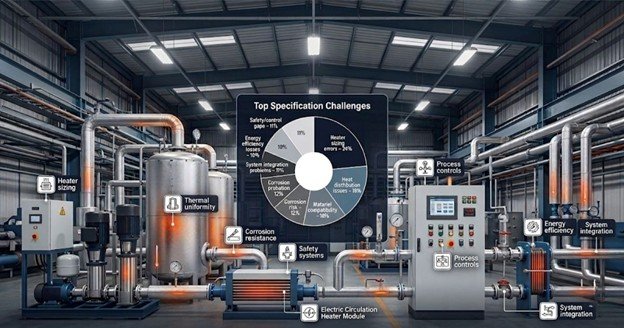
Here are some of the most common specification challenges engineers face when designing and selecting process heating systems. Understanding these challenges can help you make more informed decisions and develop heating solutions that meet the performance, safety, and efficiency requirements of modern industrial facilities.
Defining Accurate Process Heating Requirements
One of the most significant challenges in specifying process heating equipment is accurately defining the thermal requirements of the industrial process. Each application has unique heating demands depending on the material properties, process temperature, and required heating duration. Without a precise understanding of these factors, selecting the right equipment becomes difficult and may result in systems that either underperform or waste energy.
Industrial heating systems must deliver controlled heat at specific temperatures while maintaining stability throughout the process. Heating requirements typically vary depending on the material being processed, the reaction or transformation occurring, and the time required to reach operating temperatures.
When defining process heating requirements, you need to assess several technical parameters:
Material thermal properties: Heat capacity, density, and thermal conductivity determine how quickly a material absorbs and distributes heat.
Target operating temperature: Many industrial processes require precise temperature control to maintain product quality and avoid degradation.
Heating rate and cycle duration: Some processes require rapid heating, while others require gradual heat buildup to prevent thermal stress.
Production throughput: Changes in production rates may alter heating demand and require flexible system capacity.
A well-defined heating requirement ensures that the system provides sufficient energy without oversizing the equipment. Accurate thermal calculations are essential because heater capacity is typically determined based on the mass of the material, its specific heat capacity, and the temperature change required during the process.
Selecting the Appropriate Heat Transfer Method
Industrial heating systems can rely on different heat transfer mechanisms such as conduction, convection, or radiation. Choosing the appropriate method depends on the characteristics of the material being heated and the design of the processing equipment.
Some processes require direct heating where the heat source interacts directly with the material. Others rely on indirect heating methods, where heat is transferred through an intermediate medium such as thermal oil, steam, or air. Each method presents different specification challenges related to efficiency, equipment design, and operational safety.
In many industrial heating systems, the heat is delivered through a transfer medium. Here are the factors you need to consider when selecting the most suitable medium:
Thermal stability: The heat transfer fluid must withstand the required operating temperatures without degrading.
Heat capacity: Fluids with higher heat capacity transfer heat more efficiently and maintain stable temperatures.
Viscosity and flow characteristics: These influence circulation efficiency and heat transfer rates.
System pressure requirements: Some heating fluids operate at higher pressures, requiring stronger system components.
Choosing the wrong heat transfer medium can reduce system efficiency or create maintenance problems.
Heater Sizing & Capacity Calculation Challenges
Another common challenge when specifying process heating equipment is determining the correct heater capacity. Proper heater sizing ensures that the system can reach the desired temperature within the required timeframe without excessive energy consumption.
If a heater is undersized, the system may struggle to maintain process temperatures, leading to production inefficiencies. Conversely, an oversized heater can result in unnecessary energy usage, higher equipment costs, and potential overheating risks.
Improper heater sizing remains one of the most frequent causes of performance problems in industrial heating systems. Several factors influence heater sizing calculations:
Mass flow rate of the process fluid
Required temperature increase between the inlet and the outlet
Heating time required for the process cycle
Thermal losses due to insulation and system design
Accurate sizing requires detailed process data, including fluid flow rates and system heat losses. Remember to apply safety margins to account for unexpected operational conditions or variations in process demand.
Ensuring Uniform Heat Distribution
In processes involving viscous fluids or chemical reactions, uneven heat distribution can lead to temperature gradients that affect product quality or reaction efficiency. Hot spots may damage materials or degrade sensitive fluids, while cooler areas may prevent the process from reaching the required temperature.
Several design elements influence heat distribution within process heating systems:
Heater placement within vessels or pipelines
Fluid circulation patterns and mixing efficiency
Equipment geometry and internal baffles
Thermal insulation and heat retention capability
Advanced engineering tools such as computational fluid dynamics (CFD) simulations are often used to analyze heat transfer patterns during the design stage. These simulations allow engineers to optimize heater placement and improve thermal uniformity before installation.
Maintaining consistent heat distribution is critical because industrial heating systems must deliver heat precisely where and when it is needed to maintain process stability and minimize energy waste.
Addressing Material Compatibility & Corrosion Risks
Industrial heating equipment frequently operates in harsh environments involving high temperatures, corrosive chemicals, and fluctuating pressures. Selecting the correct construction materials for heating equipment is, therefore, crucial.
Material compatibility becomes particularly important when heating aggressive fluids such as acids, solvents, or highly reactive chemicals. If the heater materials are not resistant to corrosion or thermal stress, equipment failure can occur prematurely, leading to expensive repairs and operational downtime.
Here are the top material properties to evaluate when specifying heating equipment:
Corrosion resistance against process chemicals
Maximum operating temperature tolerance
Mechanical strength under pressure and thermal expansion
Compatibility with heat transfer fluids
Common materials used for industrial heating elements and components include stainless steel alloys, nickel-based alloys, and specialized coatings designed for corrosive environments. Selecting the right materials ensures that the equipment maintains structural integrity and operational reliability over long periods.
Integrating Heating Equipment with Overall System Design
Process heating equipment rarely operates as an isolated component. Instead, it must function as part of a larger industrial system that includes pumps, pipelines, storage vessels, control systems, and safety instrumentation. Integrating heating equipment with these systems can present significant design challenges.
For example, heating equipment must be positioned in a way that allows proper fluid circulation while maintaining accessibility for maintenance and inspection. Additionally, electrical power requirements must be considered to ensure the facility’s infrastructure can support the heating load.
Key integration issues include:
Space constraints within equipment layouts
Compatibility with existing piping and mechanical systems
Electrical supply capacity and control integration
Maintenance accessibility and operational safety
Digital engineering tools such as CAD modeling and 3D plant design software are commonly used to visualize equipment placement and identify potential conflicts before installation. Proper integration ensures that heating systems operate efficiently within the broader production environment.
Energy Efficiency & Sustainability Considerations
Energy consumption is a major concern in industrial heating systems. Process heating accounts for a significant portion of industrial energy use and contributes substantially to overall greenhouse gas emissions associated with manufacturing operations.
For this reason, you must consider energy efficiency when specifying heating equipment. Inefficient heating systems not only increase operational costs but also contribute to unnecessary environmental impact.
Several design strategies can help improve the efficiency of process heating systems:
Optimizing heater capacity to match actual process demand
Improving insulation to reduce heat losses
Implementing advanced temperature control systems
Recovering waste heat for reuse in other processes
Energy-efficient heating systems help reduce operating expenses while supporting sustainability initiatives in industrial facilities.
Safety & Operational Reliability Requirements
Industrial heating systems operate at high temperatures and often involve pressurized fluids or flammable materials. Ensuring safe operation is therefore one of the most critical aspects of specifying process heating equipment.
Heating equipment must incorporate safety mechanisms to protect both personnel and equipment from hazardous conditions. These features help prevent overheating, equipment failure, and potential process accidents.
Below are several safety measures to keep in mind when specifying industrial heating equipment:
Temperature monitoring and control systems
Overheat protection devices and automatic shutdown mechanisms
Pressure relief systems for pressurized vessels
Electrical protection systems, such as grounding and leakage detection
Modern process heaters often include built-in safety controls that automatically shut down the system if unsafe operating conditions are detected. Proper safety design not only protects workers but also helps maintain continuous plant operations by preventing unexpected equipment failures.
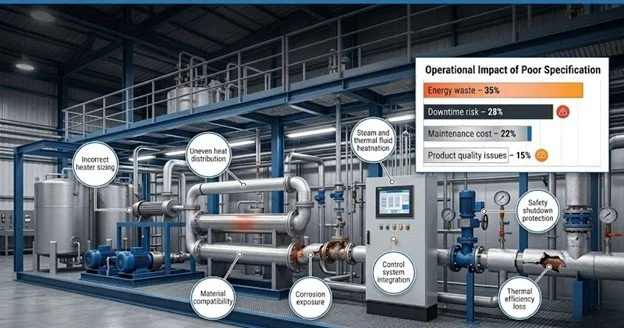
Types of Process Heating Equipment Used in Industrial Applications
Industrial heating systems use different technologies depending on the process requirements and operating conditions. Each type of heating equipment offers distinct advantages related to temperature control, efficiency, and system design.
Electric Process Heating Systems
Electric heating systems generate heat through electrical resistance elements and are widely used in industrial applications that require precise temperature control. These systems are known for their efficiency, quick response time, and compatibility with automated control systems. Because they do not rely on combustion processes, electric heaters are often easier to install and maintain in modern industrial environments.
Steam Heating Systems
Steam heating remains a traditional and widely used method for delivering thermal energy in industrial facilities. Steam systems distribute heat through pressurized steam generated by a central boiler. These systems are particularly effective in large-scale operations where multiple pieces of equipment require a consistent heat supply.
Thermal Fluid Heating Systems
Thermal fluid systems use specialized heat transfer fluids to deliver heat at high temperatures while operating at relatively low pressure. These systems are commonly used in industries that require stable and controlled high-temperature processes. Their ability to maintain consistent heat transfer makes them suitable for applications such as chemical processing and plastics manufacturing.
Best Practices for Specifying Process Heating Equipment
Applying best practices during the specification stage helps ensure that heating systems perform reliably throughout their operational life.
Collaboration with Equipment Manufacturers
Working closely with experienced equipment manufacturers can improve the specification process. Manufacturers provide valuable insights into equipment capabilities, materials, and performance characteristics, helping engineers select systems that match the process requirements.
Using Detailed Engineering Documentation
Accurate engineering documentation, such as technical drawings, data sheets, and performance specifications, plays an important role in equipment selection. These documents help you verify that the heating equipment meets the design requirements and integrates properly with other components in the facility.
Designing for Maintenance & Future Expansion
Heating systems should be designed with maintenance accessibility and future scalability in mind. Equipment that is easy to access and service reduces downtime and simplifies routine inspections. Planning for potential future expansion also ensures that heating systems can adapt to changing production requirements without major redesigns.
Conclusion
Specifying process heating equipment is a complex task that requires careful evaluation of thermal performance, system integration, material compatibility, and operational safety. Industrial heating systems must deliver precise and reliable heat while maintaining energy efficiency and compliance with safety standards.
Many specification challenges arise from incomplete process data, improper heater sizing, or insufficient coordination between engineering disciplines. By carefully analyzing process requirements, selecting appropriate heat transfer methods, and integrating advanced design tools, you can overcome these challenges and develop heating systems that operate efficiently and reliably.
As industrial processes continue to evolve and demand greater efficiency and sustainability, proper specification of process heating equipment will remain a critical factor in ensuring optimal plant performance and long-term operational success.
Looking for the right products for your next project? Find what you need on CADdetails.
Author: Ilan Toledano is an industrial heating specialist and contributor at Wattco, a manufacturer of electric industrial heating solutions used in manufacturing, oil and gas, chemical processing, and water treatment. With experience in process heating technologies and industrial applications, he focuses on helping engineers and plant managers improve operational efficiency through reliable heating systems and smart temperature control solutions. His writing covers topics like energy-efficient heating methods, equipment reliability, and strategies that help facilities reduce operational costs while supporting sustainable industrial operations.
Cover image by EJ Yao on Unsplash